African Crown Colonies
of the British Empire
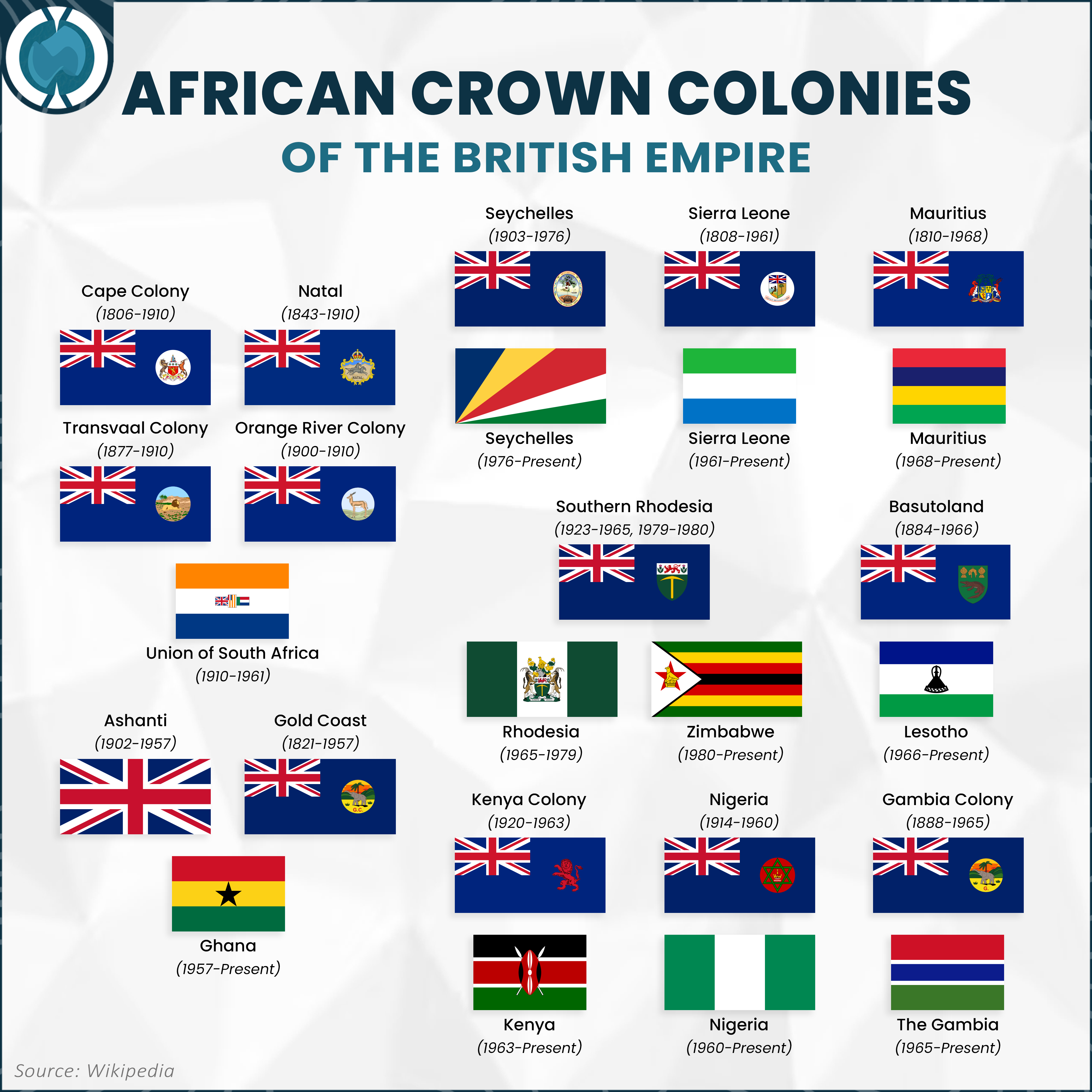
Imperial administrative consolidation elucidates a complex stratification of power in Southern Africa, where the Cape Colony (1806–1910), Natal (1843–1910), Transvaal (1877–1910), and Orange River Colony (1900–1910) aggregated into the Union of South Africa in 1910. Conversely, West African territories demarcate prolonged periods of colonial governance, evidenced by the Gold Coast’s 136-year tenure (1821–1957) before unifying with Ashanti (1902–1957) to manifest as Ghana in 1957.
Temporal disparities are further underscored by the insular territories, with Mauritius enduring 158 years of British rule (1810–1968) and Sierra Leone 153 years (1808–1961) prior to independence. The mid-20th-century decolonization wave is visualized through the rapid succession of independent states, including Nigeria (1914–1960), Kenya (1920–1963), and The Gambia (1888–1965), while Southern Rhodesia’s fractured timeline (1923–1965, 1979–1980) and the 14-year interval as Rhodesia (1965–1979) reveal a volatile path toward Zimbabwe’s 1980 emergence.
Colony Data and Timeline
|
Crown Colony
|
Present-day Country
|
Year of Colonization
|
Year of Independence
|
|---|---|---|---|
| Cape Colony |
 South Africa
|
1806 | 1910 |
| Natal |
South Africa
|
1843 | 1910 |
| Transvaal Colony |
South Africa
|
1877 | 1910 |
| Orange River Colony |
South Africa
|
1900 | 1910 |
| Ashanti |
 Ghana
Ghana
|
1902 | 1957 |
| Gold Coast |
Ghana
|
1821 | 1957 |
| Nigeria |
 Nigeria
|
1914 | 1960 |
| Sierra Leone |
 Sierra Leone
|
1808 | 1961 |
| Kenya Colony |
 Kenya
Kenya
|
1920 | 1963 |
| Southern Rhodesia |
 Zimbabwe
|
1923 | 1965, 1980 |
| Gambia Colony |
 The Gambia
|
1888 | 1965 |
| Basutoland |
 Lesotho
|
1884 | 1966 |
| Mauritius |
 Mauritius
|
1810 | 1968 |
| Seychelles |
 Seychelles
|
1903 | 1976 |